
| Home | Patterns of Mind | Chapter 3: Attitudes | Table of Contents | Glossary |
| < previous | next > |
The links in the table on the left take you to sub-headings on this page.
| . |
Linking Attitudes to other States of MindOne way to get started on attitude analysis is to consider why some attitudes are easy to change and others are much harder to change. External factors, such as environment and social situations, can modify or change some attitudes, whilst other attitudes are highly resistant to the influence of any external factors. What is it that sustains resistant, entrenched attitudes? We need to consider what factors make up attitudes. Social psychology theory assumes that attitudes have three factors, those of affect, cognition and behaviour. The affective factor is how the person feels about the object of the attitude; the cognitive factor is what the person believes the object is like; and the behavioural factor is how the person responds to the object. The object of the attitude can be situations, social issues, relationships, etc. What we have here are links between affect (emotion), cognition (belief), attitude, and behaviour. However, in my understanding, the ways that these states of mind link together form a slightly different pattern. So this social psychology model is not quite accurate. |
| Sub - Headings | |
| Stage 1 – Factors to Consider | |
| Adding Motivation and Drives | |
| Stage 2 - adding Behaviour | |
| Stage 3 - adding the Situation and Learning | |
| Stage 4 - adding Traits | |
| References |
I use my own variation of this model to map out a pattern of ego responses to the circumstances that the ego finds itself in. My model is a product of my psycho-dynamic sensitivity. To explain the model I separate it into six stages. The starting point is the ego (or the “I” consciousness, or the personality, or what the person thinks is himself /herself ). First of all, states of mind are influenced by both subjective and objective factors. To begin the analysis, I need to contrast subjectivity with objectivity, and I do this by contrasting meanings and values.
Meanings and values lie in the nature of the relationships which a person has. Meanings are individualist and thus give rise to subjective beliefs: I consider what meanings all my relationships have for me. Values are social and give rise to objective beliefs: I consider the value that relationships have for me. Subjectivity always arises before objectivity. Hence meanings arise before values do. If something has meaning for me, then eventually I will learn to value it. The course of a person’s life is shaped by the way that his meanings gradually transform into values.
Meanings are what a person feels about anything. Meanings become the way that life is lived, lived in all its drama. The meaning of anything is just what that thing can teach him. For example, the exploration of relationships for their meaning is the exploration of the significance of these relationships for the individual, the exploration of the quality of life that they offer. Relationships pose problems. What happens to relationships when attachments to power and dependency are overcome? What forms does harmony take? Can harmony arise at all in his relationships? By following the concept of meaning the explorer will find that his relationships change as his understanding of them changes. Meanings give rise to flexible beliefs, beliefs that the person is willing to change if necessary. Hence meanings give flexibility to character and facilitate the ability to change.
Values tend to become permanent since they are part of the social consensus. However, as a general rule, society does not like to change. Hence values tend to inhibit the person’s flexibility and willingness to change; by being inflexible they give structure and an element of rigidity to his character. Values help to determine his actions and behaviour. Hence they are objective.
Now I can return to my model of
attitudes. I begin with the link between the ego and its beliefs, and
how these beliefs connect to standards, needs and ideals.
| Top of Page |
In this stage, I look at
various ideas in order to connect together beliefs, ideals, needs, and
standards.
One
definition of an
attitude is that it is a belief that contains a
value ingredient, an ingredient of what the person thinks is good,
worthwhile, esteemed, etc. So we need to look at beliefs and values.
Obviously some values are more important than other ones, so we can
arrange them in a scale of importance, thus forming a hierarchy of
values.
The values that a person adheres to usually indicate his /her level of character development. They can range from survival values at the lower end of the hierarchy of values to highly abstract ethical codes at the higher end. An example of a survival value is stealing from the rich in order to offset actual poverty; this is a non-moral value. Whereas stealing from the rich in order to offset “relative” poverty is an immoral value. Comparing these two, I consider that stealing from the rich to offset actual poverty has a higher value than stealing to offset relative poverty.
Standards can be considered to be values that have permanence and significance for the person: these can be non-moral, immoral, moral, ethical or aesthetic values. The standards shape, and can even determine, the person’s beliefs.
Needs are often non-moral values or requirements. These are usually either physiological requirements (such as the need for shelter, warmth, food), or psychological requirements. The two basic psychological requirements are the need for validation and the need to be authentic.[¹]
A person also has ideals. In my model, ideals arise from within the person’s concept of himself in relation to reality. If his view of reality is simply a materialistic view, then his ideals will correspondingly be only materialistic ones. If he has a wider understanding of reality then his ideals will aim higher than the materialistic level. Ideals need their place in the pattern of ego responses. Standards and ideals are separate factors. A person can have standards but no ideals – he is content with his place in life. Ideals are different, since they incorporate motivation.
Both ideals and standards
reflect the person’s pattern of beliefs. Beliefs can be
separated according to whether they reflect meanings or values. My way
of looking at the differences between
them is:
Ideals
carry meaning, and meaning is subjective.
Standards
carry value, and values are objective.
An ideal generates the person’s aspirations, hopes and ideas of personal development: they influence the quality of his life. Standards are rules and precepts which the person accepts and follows: they influence the way that he lives his life. The process that links them together occurs when the person uses his ideals to evaluate and assess his standards: this process facilitates character development. Character development occurs by upgrading present standards to meet the exigencies of new problems, which often demand new skills, in new situations.
Beliefs arise from the person’s interpretations of stimuli from the situations that he finds himself in, or from issues that he is interested in. He evaluates each situation or issue according to his ideals, needs and standards, and modifies existing beliefs to accommodate any new stimuli. The results of numerous evaluations are the productions of beliefs that are important to the person: these beliefs now carry built-in values and meanings. A belief that carries no value or meaning cannot lastingly influence a person.
An attitude has a factor of belief. When the belief carries value or meaning, then the attitude derived from the belief carries the same value or meaning as well.
Usually there are regular occurrences of conflict between different values. The conflict may be resolved in two ways. The way that any conflict between standards is resolved can be different from the way that any conflict between ideals and needs is resolved. A higher standard will overrule a lower one. However, the reverse is often true of ideals and needs. When we are confused, when our beliefs about some aspect of ourself, some aspect of our personality, contain confusion or self-deception, then we will have a weakness in that aspect of our personality. In this state of affairs, a lower need will often negate a higher ideal.
In general, in any aspect of
personality that is weak, the ego’s needs often outweigh
ideals for that aspect. For example, for a confused ego, the desire to
survive can be more important than social
or ethical ideals.
I connect all these ideas as shown in Diagram 6a. The "I" consciousness gives rise to values which become standards , which in turn give rise to beliefs. Then those beliefs give rise to ideals and needs.
Diagram 6a: Pattern of Ego Responses 1a
| Top of Page |
Another factor to consider is motivation, which reflects the reasons why a person follows their ideals and desires. It is either the desire to experience something or the desire to achieve something, and takes the form of two drives, which I label primary and secondary ones (a drive denotes how much emotional intensity you put into following your motivation).
Primary motivation is egotistical and occurs through the desire to satisfy needs. This is the egotistical or “outer” drive, since it relates to the influences on the ego of external factors; these factors are usually the influences of materialism plus any social relationships that involve dependency, status, wealth or power.
Secondary motivation comes from the person’s ideals of “the good life”; this is an “inner” drive since it focuses on spiritual influences that often originate from the higher self. Two common names for the higher self are “the silent watcher” and “the witness”. Although the higher self generates the inner drive, it is the ego that controls the expression of it. This control is exercised through the ego’s ideals. Only when the primary motivation is fulfilled will the drive from the higher-self become pre-eminent.
My view that a higher-self drive exists is based on direct experience. One day I was resting on my bed and feeling listless, with no goal to aim at. Then I clearly felt for the first time my inner drive. It is within the heart (or heart chakra), but it was ticking over in neutral: the drive never stops, but self-pity dis-engages it. My empirical detection of this drive showed me that it represents just a neutral power; it is the ego, through its ideals, that adds passion (that is, intensity) to this drive.
Drives function through ideals (the higher-self drive) and needs (the egotistical drive), and not through standards. Both drives can be easily neutralised. For example: ideals may be associated only with phantasy and wishful thinking – their implausibility prevents the drive from functioning effectively. Needs may be subordinated to strong ideals, especially if the person has an ascetic side to his character or is focused on attaining some form of power.
A depressed person has standards, but no motivation; depression shows that motivation is separate from standards.
Motivation and standards react
on one another. For an immature person, primary motivation is strong
and standards are often low. As the person evolves his character
(through the process of reincarnation), primary motivation becomes less
important, thus allowing secondary motivation to become stronger in its
influence. As primary motivation decreases in intensity, so the
person raises his standards.
Summary
of Stage 1
I summarise these ideas
so far.
From the ego emanates standards and primary motivation, which create
and sustain beliefs. Beliefs create both needs and ideals. The inner
drive originates from the higher self and helps to provide the
motivation for the ego’s ideals. I fit these together into a
pattern; see the diagram below.
The arrows
in the
diagram show the direction of influences.
Diagram 6b: Pattern of Ego Responses 1b

| Top of Page |
In this stage I add moods, goals, and behaviour, plus feeling (first part). I use social psychology theory to help me; this theory assumes that there are links between affect (emotion), cognition (belief), attitude, and behaviour. Now I introduce the way that I link them together.
In my understanding, the antecedent factors of behaviour are moods, goals and attitudes. Attitudes are mainly the likes and dislikes that a person has to the attitude objects. Moods are states of emotion, and goals are states of desire. Moods are affected by beliefs, and so are goals and attitudes; therefore beliefs are an ingredient of all these three factors. However, there is a difference: beliefs are channelled into goals via the person’s needs and ideals.
Goals can channel motivation, but moods and attitudes do not. Goals produce motivated behaviour because they reflect how we interpret our needs and what ideals we aspire to achieve or experience. Our aspirations and our interpretations of what we need may be governed by a hierarchy of values.
Another influence that we need to take into consideration is that of feeling. Feeling is of three kinds: the positive feeling, the negative feeling and the neutral feeling. These are the bases of all emotions [²]. And feeling is also a factor of attitudes, helping to give rise to likes and dislikes.
In contrast to moods and goals, attitudes produce style of living behaviour. This is behaviour that just expresses the person’s relationship to the situation (or other attitude object), behaviour that is just an habitual response. Style of living refers to what is already accomplished and where needs and goals no longer apply.
For example: we may desire to be friendly to everyone (this is an ideal). We become motivated to show friendliness whenever we can. After a sufficient period of learning, friendliness has become part of our character, it has become a trait. Now we are automatically a friendly person. We have acquired an attitude of being friendly to people that we meet, so the motivation to be friendly ceases.
Summary
of Stage 2
All moods, goals and attitudes have a factor of belief; all three lead
to behavioural responses. For goals the beliefs are filtered through
the person’s needs; in addition, goals provide the channels
for idealistic motivation. Feeling is directed into moods and
attitudes. The pattern of responses has become extended: see the
diagram below. (Some lines are coloured simply to indicate that they do
not interact with black lines they cross).
Diagram
6c: Pattern of Ego Responses 2

| Top of Page |
Now I add the situation and its stimuli. In this stage I explain how learning occurs within all forms of relationships – social, political, religious and sexual ones.
So far the pattern is presenting a single direction of influence, from ego to the resulting behaviour. However, psychological learning ( learning about oneself and others) requires a feedback channel. There has to be a link from the end state to the initial state in order to explain learning. But learning has two quite separate modes, because the person has two sides to their character: their individual identity and their social identity.
For example, artistic creativity and intellectual interests enhance the individuality of a person; individuality reflects self-interests and self-reliance. Whereas relationships relate to the social identity of the person; relationships usually reflect reliance on, and concern for, other people.
Both identities learn from situations but they learn differently. It is necessary, on the pattern of ego responses, to interpose the situation or context between moods /goals /attitudes and behaviour. Consider the two extreme ends of one dimension of personality, the introvert and the extrovert, and how they learn.
Introverts do not change their behaviour much in any situation. The effects of their behaviour are not always of interest to them. Learning primarily occurs through the subjective analysis of the situation alone; an objective analysis of their behavioural responses is not very important to them. Introverts analyse the situation and learn how it affects their ideals. The situation generates internal stimuli, which are the introverts’ subjective assessments of what meaning can be attached to the situation. It is the individual aspect of their personality that learns most.
In contrast, extroverts play the opposite game. The situation generates external (objective) stimuli, which are the extroverts’ objective assessments of what value can be attached to the situation. Extroverts monitor their behaviour and see how it affects their standards. They moderate, even change, their behaviour to suit their social needs. Learning primarily occurs through the objective analysis of behaviour and its consequences. It is the social aspect of their personality that learns most.
The overall response of an average person will be a blend of internal and external stimuli, depending on their relative importance to him.
Learning also occurs from sources completely unlike the sources (or attitude objects) normally met with. These are the influences of inspirational and spiritual stimuli. Sources of these stimuli can be the person’s higher self, visions, some types of dreams, and highly developed teachers such as Jesus, Buddha, Aurobindo. All these sources produce internal stimuli as the response to the situation.
Summary
of Stage 3
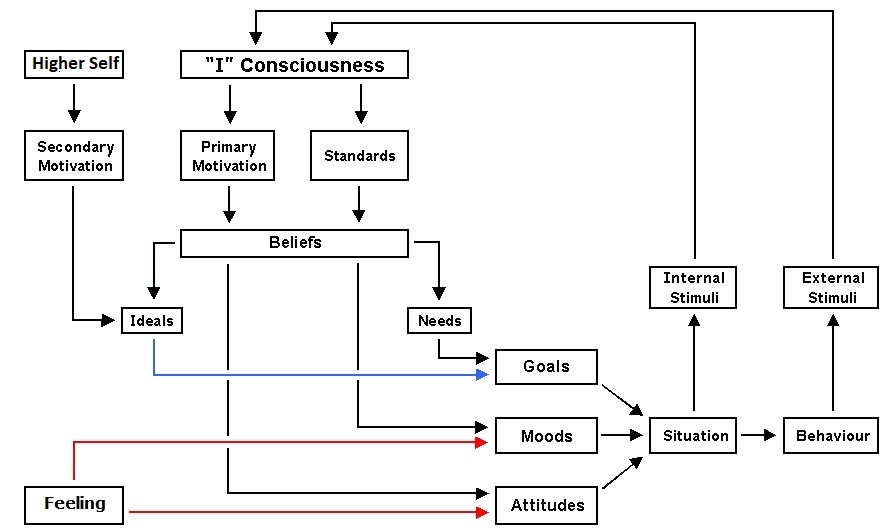
I put these ideas together into a new pattern. The situation is
interposed between behaviour and its three factors of moods /goals
/attitudes. Internal stimuli arise from the situation and external
stimuli from the behaviour. These stimuli act directly on the ego, so
that the ego can learn from the situation. The pattern is now the
diagram below.
Diagram
6d: Pattern of Ego Responses 3
| Top of Page |
Now I add traits and will (or will power), plus motivation and feeling (second part).
I bring in traits, which can be relatively stable and permanent characteristics of the person: for example, being industrious, ambitious, progressive, pleasure-loving, sly, imitative, shrewd, efficient, cruel, arrogant. Traits are derived from the person’s will (or will power) and his /her hierarchy of standards. The factor of will gives strength to the trait, and the factor of a standard gives a value to it. The overall prominence of the trait depends on how strong the will is and how important the relevant standard is. A person’s will is never of uniform quality: in some aspects of his character the will is strong, and in other aspects it is weak.
Just as a person has two sides (individuality and social-centredness) to their character, so traits divide up to reflect these two sides. Social traits like aggressiveness, friendliness, and caring are learned. So too, traits of individuality are also learned; for example, traits like honesty, dignity, honour, slyness and cunning do not depend on other people – a person can prefer to maintain his honesty even if he is in a situation where he can be dishonest and never be found out.
Traits are not always easy to acquire, they have to be desired and achieved. Some good traits are not always felt to be desirable. For example, logical reasoning is an ability, but for some people the reliance on it for understanding reality is a trait ( just as other people may prefer to rely on emotional experience as the way to comprehend reality). This reliance on logical reasoning is not always valued by some communities: for example, some religious people feel that rationality is a barrier to faith.
Extroverts learn social traits best, because these traits carry more importance for them. Introverts learn traits of individuality best.
Traits
and Attitudes
Traits link to attitudes. Overall, the strength of an attitude reflects
the strength of the trait that underpins it: weak traits produce weak
attitudes, attitudes that can be easily changed when the associated
belief changes, whilst strong traits produce strong, entrenched
attitudes. The difference between traits and attitudes is that an
attitude can direct behaviour, because it partly arises from feeling
and belief, but the trait is non-directive. The feeling and belief
factors of the attitude help to shape the behaviour; the trait is just
a characteristic of personality.
The person uses both their beliefs and feeling to decide whether the context or situation is a suitable one for expressing a trait, and what limits are to be put on the expression of the trait: this combination produces a context-specific attitude. Therefore an attitude is a blend of one or more traits, along with relevant beliefs and an underpinning of feeling.
For example, consider a man who is aggressive (he has aggressiveness as a major trait). His aggressiveness will vary depending on how he interprets the situation; his response is unlikely to be a uniform one, in terms of intensity of aggression, to any and every situation. His beliefs about the situation modify his responses. He may even decide, in a particular situation, that cowardice is a better response than hostility. He may well show a marked preference for being more aggressive to males than to females (or vice versa); or he may be ideologically inclined to direct his aggression to people of a different class to himself. Such preferences, or likes and dislikes, do not arise from the trait of aggressiveness but from the attitude that directs the trait.
As another example, consider
the trait of honour. This gives rise to general attitudes such as
“I will not let people down”, and “I
always take people on trust”. However, as I learn from
experience, as my beliefs become more in tune with social reality (I
learn that not everyone can be trusted), then I may moderate these
attitudes towards particular people who have proved to be unpleasant to
me in the past (though the trait of honour remains the same).
| Top of Page |
Motivation
2
Will power underpins not only traits,
but also the person’s desires and goals. In order to achieve
any particular goal, the will has to be brought into action.
Now I come back to primary motivation. Both feeling and will power channel into it. If a person wants to achieve a desire (such as accumulating wealth), then he /she focuses on will power, whereas if he /she wants to experience something (such as listening to music), then he /she focuses on feeling. In olden times, when societies were comparatively low-stress ones, the accent was usually on will power. However, in the high-stress societies of modern times the accent is more often on feeling. This is because high levels of stress accentuate our emotional responses.
When motivation is conscious, when the person knows what he wants, then it can be changed relatively easily. The problem that faces almost everyone is learning to change subconscious motivation. Subconscious motivation may be comparatively unimportant in low-stress societies because the subconscious mind of a person is not very active. Its negative emotional tones can be over-ridden by will power. However, in high-stress societies the subconscious minds of people become highly active. Nowadays the high levels of emotional stimulation make it very difficult to over-ride the influences of the subconscious mind by using will power. Hence subconscious motivation has become very important and is largely responsible for the rapid spread of violence in Western societies. It cannot be altered effectively unless the person has already developed some degree of self-awareness and is journeying through psycho-therapy.
Hence feeling, because it helps to give rise to emotions, feeds into primary motivation.
Summary
of Stage 4
To the previous pattern are added traits, which arise from the
ego’s standards and will power. Traits are factors of
attitudes,
and will is a factor of goals. Feeling and will feed into primary
motivation as well. The final pattern is the diagram below.
Diagram
6e: Pattern of Ego
Responses 4

| References |
[¹]. See my article Validation and Authenticity in my book Living in Times of Change. [1]
[²]. I have three articles on Feeling and Emotion on the Home Page. [2]
| Home | Glossary | Top of Page |
Copyright
© 2026
Ian Heath
All Rights Reserved
The
copyright is
mine, and
the articles
are free to use. They can be reproduced
anywhere, so long
as the source is acknowledged.
Ian Heath
London, UK
If you want to contact me, use the address at the bottom of the Home page.
Also, since there are numerous articles on this site, please include the title of the article if you want me to clarify or discuss particular issues.
It may be a few days before I can respond to correspondence.