| Home | Towards a General Theory of Confusion | Section 4: Maladjustment | Table of Contents | Glossary |
| < previous | next > |
The Abuse Diagram
The links in the table on the left take you to sub-headings on this page.
| . |
Primary and Secondary RootsWe can increase the usefulness of the ideas on trauma (in the previous three articles) by refining the causes of trauma into three primary roots, or causes, and three secondary roots, and one tertiary root. The secondary roots are formed by combining the influences of the three primary ones, taking two at a time. The three primary causes are singular roots, whereas the secondary causes have two roots each. The tertiary root combines all three primary influences and so has three roots. The primary emotional drivers of these states of mind are fear, guilt, jealousy, and self-pity [¹]. I list the overall effects. |
| Sub - Headings | |
| Diagram of Abuse | |
| Depersonalisation | |
| Compensations | |
| Long-Term Effects of Trauma | |
| References |
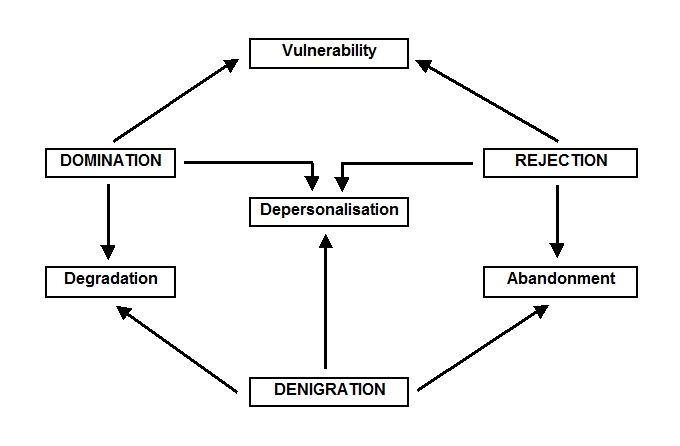
The three primary roots are:
Domination.
Major subconscious
emotions are fear and guilt (mode of self-hate).
Denigration.
Major
subconscious emotion is jealousy (mode of self-pity).
Rejection.
Major subconscious
emotion is self-pity.
The three secondary roots are:
Degradation,
through the combination of domination and denigration.
Abandonment,
through the combination of denigration and rejection.
Vulnerability,
through the combination
of domination and rejection.
The tertiary root is:
Depersonalisation, through the combination of domination, denigration and rejection.
I illustrate these patterns in the following diagram of abuse.
| Top of Page |
I look at three points in this diagram.
Looked at another way, this root is a combination of powerlessness and worthlessness. Some stages of the person's life may mirror the degradation, with him living in poor quality housing and working in low-status jobs.
At moderate intensities of emotional influences from the two roots, the person may become either passive or submissive, depending on which root is currently the most active one. He may become attracted to the pleasures of punishment within the BDSM culture (bondage, domination, submission, masochism). Whereas, at major intensities of the emotional influences, he may become compliant, and may even develop schizoid character traits.
This root is a combination of denigration and rejection. The person feels worthless because he is not loved; no one cares for him. He also feels that no one validates him; he doesn’t belong to anyone. His parents are strangers to him. He feels abandoned, so what is the point of doing anything? Apathy, listlessness, and even nihilism may set in. As compensation, he may become motivated to seek freedom, the freedom from being involved in all dreary, non-loving relationships. Freedom signifies the abandonment of many, perhaps all, forms of restraint. So the person feels the need to abandon conventional sexual morality, and authoritarian morality, and any other forms of external control on his desires for personal experience that can enhance his personal identity. The life of adventure may attract him as a way of bringing some meaning into his life.
Of all the main forms of trauma, only the experience of abandonment can produce a rebellious thinker who is not bound by the conventions of his fields of interest or by any tradition. He can be an authentic free thinker. No other forms of trauma can produce the necessary psychological independence as the basis of freedom of thought. A life of happiness never produces free thinkers of any depth: after all, if a person is happy, why should he rebel or be non-conformist?
Vulnerability is a combination of fragility and sensitivity, with their emotions of self-pity and fear [²]. Why do some elderly people become vulnerable? In my view, their subconscious conflicts from their younger days become more influential in old age, making their mental faculties slow down. These conflicts can arise from relationships, but they can also arise from the nature of capitalism, in its capacity to make a person submit to a soulless way of working for most of his or her active life. This erosion of happiness results in some elderly people losing their ability to cope in a fast-changing world. Reality becomes overwhelming. Trauma that can happen fast in childhood happens slowly in old age.
| Top of Page |
What is depersonalisation? It is a subjective experience of unreality in one’s sense of self (it is not derealisation: derealisation is unreality of the outside world). In my use of the term, it denotes that a person’s sense of having a meaningful identity has evaporated. His life has become so poor in quality that he is no longer in any meaningful relationship. Nothing that he can do makes any difference to his life and he feels that he is dancing to the tunes of fate, or he feels like a marionette having his strings pulled by the puppeteer. His core identity, or what he considers to be really him, seems to have gone; nothing in life can fulfil him because there is no longer anything in him that can be fulfilled. He just goes through life on automatic pilot.
This root is a combination of domination, denigration and rejection. The person feels completely powerless in his life, with no meaningful role in society. His interactions with assertive and dominant people induce fear in him. The fear is always in the background on his mind. The subconscious feeling of having been rejected in some significant way has the effect of crushing his self-worth: narcissism (in vanity mode) loses all its intensity. This allows self-pity to begin swamping his mind. As he begins to blame himself for being worthless, guilt in its mode of self-hatred grows in intensity in his subconscious mind, and he begins to despair about his personal identity. He begins to feel that life would be better if he could reject such a woeful identity.
When the root of rejection is the most significant of the primary roots, then if he pursues religion he will most likely gravitate to Buddhism with its central tenet of ego-denial. Ego-denial simply means the denial of the meaningfulness of a personal identity. Or he may grasp the identity of being an impersonal BDSM slave. The idea of impersonality becomes attractive to him when his self-hatred becomes intense. As a slave to a dominant BDSM Master or Mistress, his manhood is rejected and he becomes a piece of property with no personal identity: as a piece of property he is totally powerless. He ceases to have a personal name and is addressed by some derogatory name like slut. He is worthless because he has failed to be a Real Man and so he takes refuge as an impersonal slave to someone who will take charge of him and his life. When jealousy (in self-pity mode) becomes significant, then he may prefer to become attached to a Mistress rather than to a Master: it all depends on whether he gets more sexual arousal from serving a Mistress or from serving a Master.
For the person seeking a BDSM Master or Mistress, he is juggling the influences of fear and guilt (mode of self-hatred) and self-pity as they takes turns being dominant in his subconscious mind. If he still clings to a personal identity, then domination is being more influential than rejection, so that he sees himself in a submissive role rather than a slave role. If he is all too willing to abandon his old personal identity, then rejection is being more influential than domination.
When the adult feels that he was rejected as a child, he may react by deciding to go his own way in life, independent of any social or religious traditions. He rejects any kind of dependency, especially any dependence on any kind of tradition. Society rejected him, so he rejects society. What was done to him, he does to others. However, if the allure of independence is beyond his grasp, he may turn inwards and seek a way to reject his useless personal identity. He rejects the allure of independence and seeks someone to take charge of him. So the intensity with which he desires to be an impersonal slave to a BDSM Master or Mistress mirrors the intensities of his subconscious fear, guilt (mode of self-hatred) and self-pity [³].
| Top of Page |
The compensation to a negative attribute is to pursue the opposite attribute. I suggest a list of compensations to the influences of the seven roots.
| . | NEGATIVE ROOT | COMPENSATION | |
| Rejection | --- | pursue Independence | |
| Abandonment | --- | pursue Freedom | |
| Denigration | --- | pursue Honour and dignity (resolves humiliations) | |
| Degradation | --- | pursue Justice (resolves victimisation) | |
| Domination | --- | pursue Self-confidence | |
| Depersonalisation | --- | pursue Authenticity | |
| Vulnerability | -- | pursue Wholeness (resolves all of one’s weaknesses) |
The central issue in these compensations is that of fear. If, at some point of his life, his fear is overcome and so disappears as a significant influence on him, then the influences of the roots on him will change. This change will affect how he feels about himself, what he projects onto people and also what he introjects from people [4]. Hence his relationships will change too in various ways.
| Top of Page |
Overall, the experience of trauma can be put into three main categories: the sense either of powerlessness, or of denigration, or of rejection. The child may create defensive strategies of doing to other people what was done to him. Hence when he is under a lot of stress he may try to dominate relationships, or denigrate associates and partners, or reject and abandon friends and partners.
Additionally, both domination trauma and denigration trauma develop the appeal of violence as a way of solving one’s troubles. The adult acts out his resentments and anger through the ways that he treats other people. Powerlessness can give rise to anger and rage, whilst denigration is more likely to give rise to simmering resentment. Therefore, potentially, powerlessness can create a higher level of violence than denigration, though it depends upon the intensity of each and the age of the child when it first experienced them. Alternatively, other adults will try to keep their subconscious violence repressed, with the result that they become beset with long-term issues of guilt that seem to have no apparent causes (sometimes called “endogenous guilt”).
The long-term effect of childhood trauma is that it hinders (or may even prevent) the development of social skills in the aspects of relationships that are compromised. When the child grows up, he equates assertiveness with aggressiveness. Then when he needs to be assertive, he will be aggressive instead. This inadequacy in social skills leads to a pronounced effect on society: it helps generate the violence that plagues every society. Most social violence, especially in civilised countries, is self-maintained by infancy trauma. Each new generation experiences some degree of infancy trauma, and hence that generation will eventually become a source of violence in society. Infancy trauma leads to endemic violence in society.
The only way to work towards attaining a peaceful society is to change the conditions of childhood.
| References |
[¹]. I have three articles on Emotion on the Home page. [1]
[²]. I have some notes on Vulnerability in the article Some Vulnerabilities of the Family Life. [2]
[³]. I have another note on Depersonalisation in the article BDSM-1. [3]
[4]. Introjection and Projection are outlined in the Glossary. [4]
| Home | Glossary | Top of Page |
Copyright
© 2026
Ian Heath
All Rights Reserved
The
copyright is
mine, and
the articles
are free to use. They can be reproduced
anywhere, so long
as the source is acknowledged.
Ian Heath
London, UK
If you want to contact me, use the address at the bottom of the Home page.
Also, since there are numerous articles on this site, please include the title of the article if you want me to clarify or discuss particular issues.
It may be a few days before I can respond to correspondence.