| Home | Patterns of Mind | Chapter 1: Unconscious Patterns | Table of Contents | Glossary |
| < previous | next > |
The links in the table on the left take you to sub-headings on this page.
| . |
The LoopHow do projection and introjection actually work? First of all, the way that I separate them is that projection centres primarily on desire, and introjection primarily on emotion. Then the way that I put them back together forms them into a loop. The two mechanisms can be thought of as meshing together and forming a loop, or circle, in the way that they function. Therefore the loop of projection and introjection is a loop of desire and emotion. The loop ties together the person’s desires with the emotional responses to those desires. The functioning of the loop is moderated by the person’s attitudes and beliefs, which are more durable then desires and emotions. As an example, a simple desire-emotion loop occurs when I become hungry. I satisfy my desire for food by eating something that gives me pleasure. Projection and introjection handle values. The need to satisfy my hunger is one of my values, and so is the use of food that gives me pleasure when I eat it. Hence projection and introjection are involved in satisfying hunger. I project desire onto food that I prefer, and then introject the good feelings either from the appearance of the food or from memories of past meals. Here introjection functions as suggestion. This loop can be completed as soon as the desire arises. |
| Sub - Headings | |
| Summary of These Ideas | |
| Forming the Loop | |
| Route of Using the Will | |
| Route of Controlling the Will | |
| Completing the Loop | |
| References |
A problem is created when no fast solution is possible. For example, if I am a weakling and get bullied, I may desire to build my body into a strong physique in order to be able to defend myself and to derive satisfaction from the banishment of fear. The desire to defend myself becomes one of my values. But the creation of a strong body will take time and cannot be accomplished immediately. In this type of situation I find that phantasy arises so as to fill the gap. The desire-emotion loop becomes completed in imagination. I have to remain content with imagining what my quality of life will be like once I achieve a strong body. Imagination or phantasy is used to create deferred value.
Values arise from the transformation of my subjective attitudes and desires into objective, tangible skills and achievements. When I have to defer a value then I have to postpone the objective fulfilment of a subjective attitude to life. As I continue my body-building exercises my body transforms into a hulk, and fear ceases. Then phantasy has become fact, and deferred value has transformed into present reality. Deferred value has become objective value.
However, a more complex spectacle occurs in a social situation. Understanding how the loop actually operates clarifies the basis of social dynamics, that is, the basic way that people behave in any relationship. To understand how the loop operates consider two people relating to each other, one being a master X and the other one a slave Y. Extreme forms of relationships are usually easier to understand than moderate forms. (I was influenced in my terminology by the writings of Friedrich Nietzsche). At first glance it seems that master X expresses his desires and commands, and that slave Y’s emotional response is to accept his lot in life by obeying the master. But this glance is deceptive; what is going on is not quite what the two participants think is going on. The master is issuing commands and the slave is obeying them. That is true enough. However, it is the roles of desire and emotion that complicate the relationship.
First the two people agree (voluntarily or involuntarily) to the form of their relationship (for example, master-slave, husband-wife). Then each person brings to that relationship a common feature, which is the manner in which desires and emotions are handled.
Concepts are part of the contents of mind. So the common feature of a relationship centres on a certain manner of using the mind. When desires and emotions are influencing each person then what is going on is that mind is being both projected and introjected. What the two people are doing is using their minds in such a way that each can be both player and audience.
I go into more detail about what is happening between master X and slave Y. Master X projects a desire and so displays an attitude or creates an impression of himself. Slave Y subconsciously feels or senses that attitude /impression. Past associations with that kind of attitude /impression induces in him a requisite (for him) emotion, such as the joy or the sadness in having little or no freedom. Introjection occurs from a person’s own expectations and memory, and not from the other person. Slave Y can then project the attitude /impression that he accepts being a slave. When master X senses this attitude /impression then it induces in him a requisite (for him) emotion, such as the joy of being in control of someone else.
When the projection from X matches the introjection by Y, and the introjection by X matches the projection from Y then we have a complementary relationship. When they do not match then the relationship is a dissonant one. What is at issue is a concept of relationship. This means that in a complementary one, the master X projects the impression that he is the master and that Y is the slave. The slave Y introjects the impression that he is the slave and that X is the master. So X’s projection of desire induces in him a requisite emotion (the satisfaction due to being a master). And Y’s introjection of emotion induces in him a requisite desire (the desire to remain a slave). Hence in a complementary relationship we have two individual loops of projection and introjection meshing together harmoniously.
| Top of Page |
I summarise the importance of these ideas. For a loop to occur, both X and Y are projecting and introjecting as self-contained units.
Consider person Y. Y projects an impression on X. Y then introjects from that impression. If Y’s projection is coherent with X’s impression of himself then Y confirms X’s impression. The whole circuit of projection and introjection occurs within Y and does not need any contribution by X (except to be a screen that can reflect the desires and emotions of Y ).
Similarly, person X has a self-contained loop operating (so that Y is only a screen to reflect the desires and emotions of X ). Hence, except for the occasion when people are close enough together for their auras to interact, projection and introjection do not occur between people. But they do occur as a self-contained loop within the mind of each person.
The whole mechanism of the loop is geared to the person’s maintenance of his self-image (based on his sense of vanity) or to his desire for happiness and/or power. Normal relationships function via this mechanism. The loop denotes psychological immaturity. Therefore, no matter how good a person thinks that his relationships are, they are still grounded in delusion. Stripping away the delusions from this process and understanding how and why it actually works is the first step in trying to achieve genuine communication.
A relationship between two people is normally just an opportunity for each to act according to his or her current need of projection and introjection. Each person brings into their relationship only those concepts that they need to work with and express. As some concepts are worked through till their allurement ends, and other concepts arise to take their place, so the relationship changes, so the loop changes in its content too.
| Top of Page |
In order to establish the connection between projection and introjection I need to present a couple of ideas.
In the early period of my self-analysis I had been given, in a dream communication, the idea that faith acts through belief. And in another communication I was given the idea that faith drives the will. These communications came from my astral guides (other names are spirit guides or guardian angels, and represent messages from Beings who reside in heaven or higher spheres of reality).
The first idea is not hard to accept. Twentieth-century Liberal theology has tried to remove the symbolic accretions to the story of the life of Jesus. However, the symbolic accretions are very important to a lot of people, enabling them to maintain traditional beliefs. When Liberal theology crumbled these accretions, the traditional beliefs crumbled as well, so then a crisis of faith was precipitated in many people. Without a supporting belief so a life of faith can only drift this way and that, rudderless, causing moral perplexity, and becoming ineffective in the daily round. Faith is the means of tying emotion to a belief; when the belief crumbles, so the underlying emotion has no outlet for expressing itself in an harmonious way.
The second idea is more difficult to accept, since faith hardly features in the mind of any ambitious will-driven materialistic person. It can be presumed by considering the consequences of a collapse of faith (which should not be confused with a collapse of belief ). When faith is completely lost there are two reactions possible. Either the will is shattered, thereby inducing catatonia [²], or else the person creates an inflexible, rigid and domineering will that brooks no opposition. The rigidity of the will is the attempt to mask the absence of faith.
Why does the will become inflexible? Without faith so the person cannot adapt to changing times. Changing times present challenges to us and we adapt to these challenges by altering our beliefs in some ways. For example, late 20th-century Western Europe faced the need to change its beliefs on sexual expression and gender.
For the person without faith, he cannot respond to the need to change his beliefs. Hence the person tries to prevent change by making his will rigid and dominant enough in order to buttress his weaknesses and control his circumstances. If this stratagem is successful, then eventually it is likely to lead to paranoia (the person is afraid that anyone who opposes him will have the effect of weakening his control); if it fails, then the person sinks into catatonia.
As an example, consider the fate of Friedrich Nietzsche. According to anecdote, he was precipitated into madness by watching a peasant beating an overloaded mule. In my view, the inherent cruelty within the mindset of uneducated peasants finally shattered his faith in his noble idealism, and his will broke. It seems to me that his subsequent life was an oscillation between long periods of catatonia and short periods of paranoia. [³]
The average person directs his will by using his desires, rather than by using what little faith he has. So there are two factors that need to be separated: the direction of the will by either desire or faith.
Average man, average woman, may have some degree of faith (whether in religion or in science) but they prefer desire: they centre on desire as a means of utilising the will rather than on faith as a means of controlling and driving the will.
The materialist person focuses on the use of will, whereas the higher evolution of mankind necessitates the change of focus to the manner of controlling the will. The will is controlled through beliefs: beliefs govern our values and meanings. Higher development requires that beliefs become harmonious vehicles for a true faith. In this way faith can act through the beliefs and so control the will.
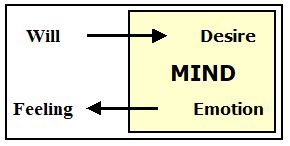
With these ideas about faith, will and belief I worked out the mechanism of the loop of projection and introjection. It has to be self-contained. First, however, I need to point out the difference between mind and consciousness. Some traditional thinkers considered that they were the same. For example, Descartes thought that will and feeling were part of the mind. Whereas, for me, mind and consciousness are different. In my understanding, the factors of consciousness are will, mind, and feeling. Will and feeling act on mind to produce desire and emotion.
| Top of Page |
In order to formulate the loop
I conceived of two half-circles, arranged around the different factors
that affect the will. First I describe the circle which represents
using the will. This is given below in Diagram
1: Route of Desire.
In this half-circle, desire is the primary feature. The
diagram represents consciousness, with the mind represented by the
enclosed yellow box.
The will
is used to interact with mind and so
stimulate desire; this desire has as its aim the generation of an
acceptable emotional response. The emotion has its base in feeling.
Desire and emotion link together through their common component of
mind. Hence this route is from will
to feeling.
Diagram 1: Route of Desire
The route of desire, from will, then to mind, and then to feeling, is the mode of projection.
| Top of Page |
This is given below in Diagram 2: Route of Belief and Faith.
In this half-circle, belief is the primary feature. Again, the diagram represents consciousness. The two ideas needed are that faith drives the will, and that faith acts through belief. Feeling is directed, via its interaction with the mind, into beliefs that are of psychological or existential importance to the person. Such beliefs become emotive ones. Unless it has a base in feeling, a belief has no lasting value to the person. Faith is almost the most powerful underpinning that can be given to a belief (only the need to survive is more powerful); when this underpinning occurs, the belief becomes a very potent factor of consciousness. Faith can be viewed as the primary basis of emotive beliefs; in other words, all such emotive beliefs have a component of faith. Beliefs are the means of creating values and meanings. As such they become the way to control the will. Hence faith acts through beliefs in order to drive the will.
Diagram 2: Route of Belief and Faith
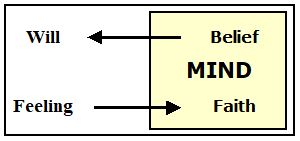
The route of belief, from feeling to mind, then to will, is the mode of introjection.
Putting these two half circles together we get the basic form of the mechanism of projection and introjection, given in Diagram 3.
Diagram 3: Primary Loop of Projection and Introjection
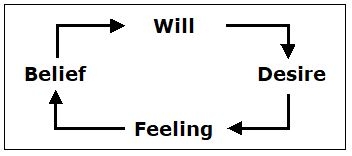
The person projects through desire and introjects through belief. He uses his will to project a desire that will bring him an acceptable emotional/feeling response. That feeling response will then support his will by means of an acceptable belief.
The introvert centres himself on the left-hand side of the loop: he finds his motivation from within himself. This focus develops character. The focus on the right-hand side of the loop generates extroversion. Perhaps call this the life style of the person.
The secondary loop of projection and introjection is described in article 5, on Power.
| References |
[¹]. These two definitions come from my articles on Emotion, which are on the Home page. [1]
[²]. I have experienced catatonia. It will be described in a future book on mental disorders. [2]
[³]. Nietzsche’s madness has baffled every writer on him that I have read. It is usually thought to be the result of syphilis, but this cannot be correct. His madness took only a few moments to happen. Whereas syphilis produces a gradual decline in mental functioning over a long period of time. Instant madness is always the result of rapid-onset catatonia. [3]
| Home | Glossary | Top of Page |
Copyright
© 2026
Ian Heath
All Rights Reserved
The
copyright is
mine, and
the articles
are free to use. They can be reproduced
anywhere, so long
as the source is acknowledged.
Ian
Heath
London, UK
If you want to contact me, use the address at the bottom of the Home page.
Also, since there are numerous articles on this site, please include the title of the article if you want me to clarify or discuss particular issues.
It may be a few days before I can respond to correspondence.