| Home | Patterns of Mind | Chapter 1: Unconscious Patterns | Table of Contents | Glossary |
| < previous | next > |
The links in the table on the left take you to sub-headings on this page.
| . |
Linking Power to HappinessHaving discussed the desire-emotion loop [¹], I now consider the way that happiness and power fit into it. Happiness is usually the preferred kind of emotional experience, and the most common kinds of desire usually centre on power (such as power over oneself, or self-control, and power over other people, and power over the environment). So the most common form of the loop ties together power with happiness. Perhaps aesthetics is the only genuine alternative that is independent of power. In the following analysis, the aesthetically-minded person can substitute the desire for aesthetic experience for the desire for power. |
| Sub - Headings | |
| Secondary Loop of Projection and Introjection | |
| Will and Emotion | |
| Mind | |
| References |
Why is power so alluring, so seductive? We have to go back to the way that projection and introjection work. When I have a desire that cannot be fulfilled immediately then phantasy or imagination is used to close the gap in the loop. I project my desire, but I have to introject my requisite emotional response from within my imagination. So my emotive beliefs are not fully real, they depend on imagination, and any severe stress can shake my faith.
The desire for power arises as the standard way of trying to validate, to make unshakeable, my expectation of happiness. The man with power is the man who can satisfy his emotional requirements. The man without power has to depend on imagination – this is the plight, and the source of creativity, of all subjective minds.
Most people have little understanding of the real dynamics of personal relationships. For such people, relationships will be understood in terms of attraction, needs, intimacy, familiarity, excitement, etc. Whereas, in my view, relationships always have an ingredient of power, except those based on equality. Power is not solely an aspect of government and law: it comes into all forms of life, both human and animal. For example, in a patriarchal family, the husband dominates the wife and the children; domination equals power. When a man seeks power then he is expecting that it will produce happiness in him. Conversely, when he seeks happiness then he is also likely to be seeking some form of power that can maintain the happiness.
I summarise these ideas. In most relationships the complement of happiness is power. A person can only be lastingly happy if he or she has the power to maintain that happiness. One without the other leads to dissatisfaction and hence to suffering.
| Top of Page |
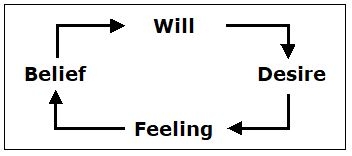
The loop of projection and introjection that I formulated in article 3, Structure of Projection and Introjection, is reproduced here as Diagram 3.
Diagram 3: Primary Loop of Projection and Introjection
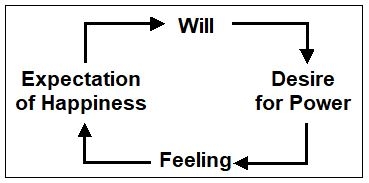
The ideas on power and happiness described above transform the loop. Now it becomes as illustrated in Diagram 4. The Desire of the primary loop now becomes the desire for power. The Belief becomes the expectation of happiness.
Diagram 4: Secondary Loop of Projection and Introjection
Freud put sexuality and aggressiveness at the base of the modern person’s character. I dispute this view. The desire for power, the desire to complete the desire-emotion loop, arises before sexuality does. At the beginning of its life the infant has to create an ego. This is its first achievement, and it requires power. In this case, power means psychic power, or the power to create the will. If its relationship to the parents is an unhappy one, thereby nullifying its power, then the resulting ego is fragile and easily de-stabilised. Whereas infant sexuality just affects the intensity of the infant’s bonding to the parents, when the ego is already in the process of creation. Aggressiveness arises from a fragile ego, from an ego that has to marshal its remaining power in order to defend itself.
| Top of Page |
The loop of projection and introjection has two parts: the control of the will and the use of the will. Each part has its own emotional dynamics. Each part leads a person along its own particular line of ethical and spiritual development.
First
I consider the Use of the Will
This has two forms. The person can use his desires either to gain power
over the environment or to gain power over people and society. The
first use is usually within the realm of science and technology, the
second within politics and morality. When the will is controlled by
desire, I call this use the
desire
for power. The desire for
power is the path of
projection.
Now
I turn to the Control
of the Will
In days of old the development of will power was often the prime focus
within concepts of ethical development, and emotions were devalued and
repressed. Nowadays it is emotional difficulties that are the major
issue: emotional problems undermine the will.
When self-pity and depression arise I can usually brush them aside by using my will. But this stratagem repels me. Will is only a stop-gap way of handling emotional problems when the intellect cannot provide an answer to them. For most of my life I have functioned on the emotional component of idealism; my will was of secondary value to me. Focusing on emotive beliefs means to search for intensity, the intensity of living experience. I prefer a natural and spontaneous holistic unfoldment, however long it takes. The unskilful use of will simply sweeps problems out of sight. But sooner or later these difficulties have to be faced. When the will is controlled by belief, I call this the will to power (more terminology influenced by Friedrich Nietzsche). The will to power is the path of introjection.
In the relations between will, mind, and feeling, which one governs the rest? Consider three suggestions.
a). The person is his or her medley of the values that he gives to life and the meanings that he seeks from life – and these are derived from mind.
b). The dynamics of life arise from the pleasant and the unpleasant feelings, but these mean nothing until they are transformed into emotions – and these require the existence of unconscious ideas [²].
c). The will has no power until it activates desire – and desire requires ideas or values to focus on.
Whichever half of the loop of projection and introjection that a person focuses on, whether on the use of will (by desire) or on the control of the will (by emotive beliefs), the deciding factor is mind.
Mind is the theatre of life
| References |
[¹]. See the article Structure of Projection and Introjection. [1]
[²]. I have three articles on feelings and Emotions on the Home page. [2]
| Home | Glossary | Top of Page |
Copyright
© 2026
Ian Heath
All Rights Reserved
The
copyright is
mine, and
the articles
are free to use. They can be reproduced
anywhere, so long
as the source is acknowledged.
Ian Heath
London, UK
If you want to contact me, use the address at the bottom of the Home page.
Also, since there are numerous articles on this site, please include the title of the article if you want me to clarify or discuss particular issues.
It may be a few days before I can respond to correspondence.